
Introduction: What Families Need to Know After a Tracheostomy
When someone you love has a tracheostomy, it’s normal to feel scared, anxious, and unsure about what comes next. Because breathing feels so basic and urgent, any change in how a person breathes can feel overwhelming at first. Patients may feel frustrated if they cannot speak clearly, feel tired from therapy, or are constantly worried about breathing. Families may feel nervous about what life for their loved ones might look like after discharge. They might often have urgent questions. Why was this needed? Is it temporary? Will they be able to breathe on their own again? Will they be able to talk and eat normally or even come home? Families who want a simple overview of how breathing works can also read SierraCare’s guide to the respiratory system.
A tracheostomy is a surgical procedure that creates an opening in the front of the neck (the stoma) to allow air to reach the windpipe and lungs. A tracheostomy is often performed after a serious illness, injury, or surgery when a person needs extra help breathing or protecting the airway. It may be needed after a long time on a ventilator, after a stroke or brain injury, because of a neurological condition, or when swelling, cancer, or trauma affects normal breathing. For some people, it is temporary while the body heals. For others, it becomes part of a longer recovery plan.
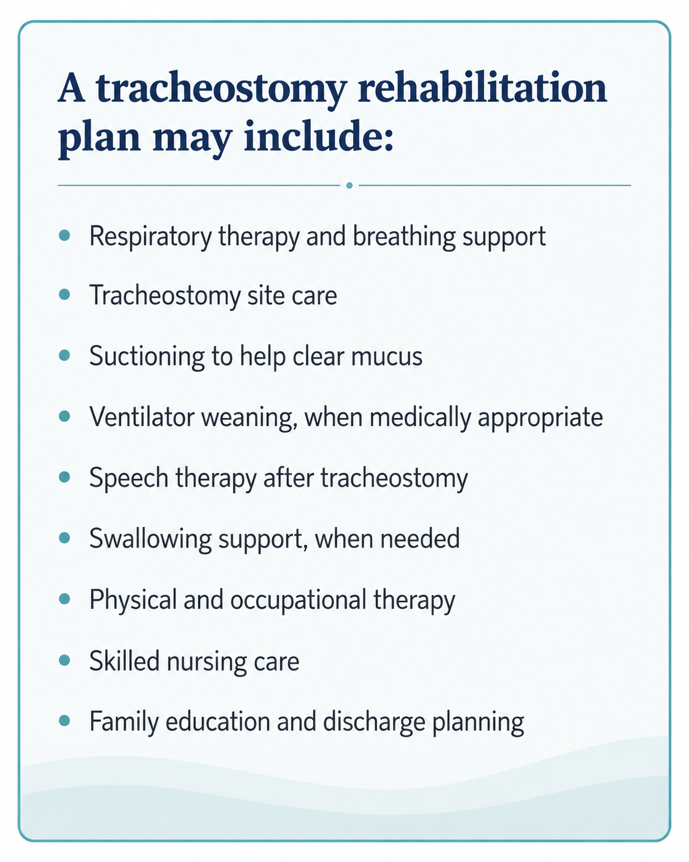
Tracheostomy rehabilitation helps patients recover step by step. The goal is to support safer breathing, rebuild strength, improve comfort, and help patients communicate when possible. Recovery looks different for every patient. Some people are working toward breathing without a ventilator. Others need help managing mucus, regaining mobility, or adjusting to life with a tracheostomy.
Tracheostomy rehabilitation gives patients and families a clear path forward after the hospital, with care focused on breathing, strength, communication, and safety.
What Is Tracheostomy Rehabilitation?
Tracheostomy rehabilitation is a coordinated care plan for people who still need support after a tracheostomy. It usually begins after the most urgent phase of illness has passed, but before the patient is ready to return home.
Tracheostomy rehabilitation helps patients recover step by step. The goal is to support safer breathing, rebuild strength, improve comfort, and help patients communicate when possible. Recovery looks different for every patient. Some people are working toward breathing without a ventilator. Others need help managing mucus or regaining mobility. In simple terms, tracheostomy therapy brings these services together so the patient can receive the right support at the right time.
For many families, this stage can feel unfamiliar because the patient is no longer in the ICU, but still needs specialized care. That is where rehabilitation after tracheostomy becomes important. It creates a safer bridge between the hospital and the next stage of recovery.
Why Patients May Need Rehabilitation After Tracheostomy
By the time a patient is ready to leave the hospital, the immediate crisis may be improving, but recovery is often still in progress. Recovery often moves through stages. First, the care team focuses on stability and airway safety. Then, the plan may shift toward strength, communication, swallowing, ventilator weaning, and discharge planning. The table below shows common needs during this process and how rehabilitation can help.
Patient Need After Tracheostomy:
Breathing Support
What This May Look Like: The patient may still need oxygen, a ventilator, or close monitoring
How Rehabilitation Helps: Respiratory therapy supports safer breathing and helps adjust care as the patient improves
Patient Need After Tracheostomy:
Airway Clearance
What This May Look Like: Mucus may be difficult to cough up or clear
How Rehabilitation Helps: Suctioning, humidification, and breathing support help keep the airway open and comfortable
Patient Need After Tracheostomy:
Weakness After Illness
What This May Look Like: The patient may feel tired, weak, or unable to sit, stand, or walk safely
How Rehabilitation Helps: Physical and occupational therapy help rebuild strength and daily function
Patient Need After Tracheostomy:
Communication Changes
What This May Look Like: Speaking may be difficult or not possible at first
How Rehabilitation Helps: Speech therapy helps patients find safe ways to communicate and may support voice recovery when appropriate
Patient Need After Tracheostomy:
Swallowing Concerns
What This May Look Like: Eating and drinking may not be safe right away
How Rehabilitation Helps: Speech therapy can help assess swallowing and guide safe next steps
Patient Need After Tracheostomy:
Ongoing Nursing Needs
What This May Look Like: The tracheostomy site, skin, medications, and overall condition still need monitoring
How Rehabilitation Helps: Skilled nursing care helps manage daily care and watch for changes
Patient Need After Tracheostomy:
Family Uncertainty
What This May Look Like: Loved ones may not know what to expect after the hospital
How Rehabilitation Helps: Education and discharge planning help families understand the care process
| Patient Need After Tracheostomy | What This May Look Like | How Rehabilitation Helps |
| Breathing support | The patient may still need oxygen, a ventilator, or close monitoring | Respiratory therapy supports safer breathing and helps adjust care as the patient improves |
| Airway clearance | Mucus may be difficult to cough up or clear | Suctioning, humidification, and breathing support help keep the airway open and comfortable |
| Weakness after illness | The patient may feel tired, weak, or unable to sit, stand, or walk safely | Physical and occupational therapy help rebuild strength and daily function |
| Communication changes | Speaking may be difficult or not possible at first | Speech therapy helps patients find safe ways to communicate and may support voice recovery when appropriate |
| Swallowing concerns | Eating and drinking may not be safe right away | Speech therapy can help assess swallowing and guide safe next steps |
| Ongoing nursing needs | The tracheostomy site, skin, medications, and overall condition still need monitoring | Skilled nursing care helps manage daily care and watch for changes |
| Family uncertainty | Loved ones may not know what to expect after the hospital | Education and discharge planning help families understand the care process |
Not every patient will need every type of support. Some people mainly need respiratory care. Others need a broader plan before the next step feels safe.
How the Care Team Supports Tracheostomy Recovery
Tracheostomy rehabilitation works best when each part of care has a clear role. When the team works together, recovery can feel more organized and safer after the hospital.
Respiratory Therapy
Respiratory therapists help patients breathe as comfortably and safely as possible. They may support airway clearance, oxygen needs, breathing exercises, and ventilator weaning when the patient is ready. Ventilator weaning means slowly reducing support from a breathing machine so the patient can breathe more on their own. This is done carefully because the body may still be weak after serious illness. Families who want to understand this type of support in more detail can read SierraCare’s guide to ventilator care and respiratory support in a sub-acute setting.
Rehabilitation Therapy
Physical and occupational therapy help patients rebuild strength for daily life. This may start with sitting up safely, improving balance, standing, walking, or practicing daily routines. Speech therapy after tracheostomy helps with communication and swallowing concerns when appropriate.
Skilled Nursing Care
Nurses help with daily tracheostomy patient care. This may include tracheostomy site care, suctioning support, administering medications, skin care, and monitoring changes in breathing or comfort. This steady support matters because many patients still have complex needs even after they no longer need ICU care. Families who are comparing care options can also learn more about the difference between long-term care and skilled nursing and how each setting may support different patient needs.
When a Tracheostomy Recovery Facility May Help
Some patients are not ready to go home right after being discharged from the hospital. Specialized respiratory sub-acute care for tracheostomy can help bridge that gap. It provides patients with continued medical support as they work on breathing, strength, communication, and daily functioning.
Specialized respiratory sub-acute care after the hospital for tracheostomy patients may be helpful when a person:
- Still needs tracheostomy care or suctioning
- Needs oxygen support or ventilator weaning
- Is weak after a long hospital stay
- Needs speech therapy, swallowing support, or mobility therapy
- Is not ready to return home safely
SierraCare offers respiratory care support and a pulmonary rehabilitation program for patients who need continued support after hospitalization. Families can also learn more about post-hospital recovery in SierraCare’s guide to a transitional care unit.
What Recovery and Progress May Look Like
Recovery after a tracheostomy is different for each patient. Some people improve quickly, while others need more time, especially after critical illness, neurological injury, or prolonged ventilator use. For some patients, respiratory rehabilitation is part of long-term respiratory recovery.
When the tracheostomy tube is removed (a procedure known as decannulation), the opening (stoma) often closes on its own over time. The care team will monitor healing and provide wound care instructions as appropriate. Progress may happen in small steps. One patient may need less suctioning. Another may sit up longer, take part in therapy, communicate more clearly, or tolerate short periods with less breathing support. These changes may seem small at first, but they can be important signs that the patient is getting stronger.
The care team watches how the patient responds and adjusts the plan based on safety, comfort, and medical readiness. Tracheostomy rehabilitation gives patients and families a clearer path after the hospital, with support focused on breathing, strength, communication, and safe next steps. For patients who need continued support after hospitalization, SierraCare’s respiratory care support can help guide the next stage of recovery.